Based on the brilliant lecture by David Tong, theoretical physicist at the University of Cambridge.
The Most Successful Theory Ever Written Has a Boring Name
Picture this: it's 1609. Galileo points a telescope at Jupiter and sees four tiny moons orbiting it. The ground shifts beneath humanity's feet — not literally, but philosophically. For the first time, something in the sky was clearly not orbiting Earth. The Copernican revolution wasn't just about planets. It was about method. About trusting mathematics over mythology.
Four hundred years later, that same method has produced something almost incomprehensible in its power:
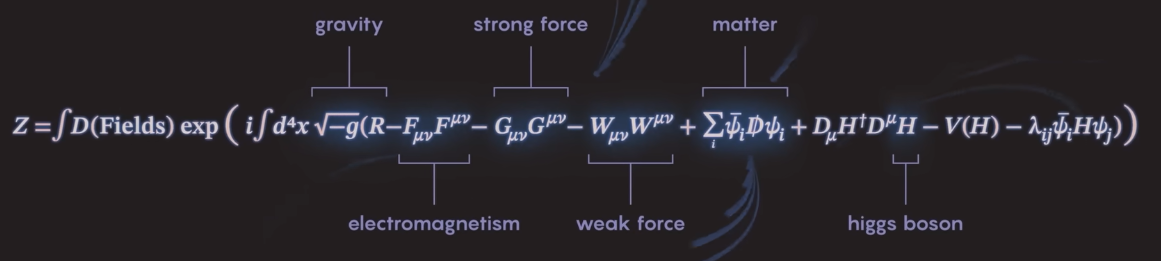
Read it from the top: is the action — a single number that encodes the entire history of the universe. It's the integral over all of spacetime () of the Lagrangian , which is the sum of every fundamental interaction: the three forces, all twelve matter particles, and the Higgs field that gives them mass. The boxed line is the principle of stationary action — Nature's deepest law. Every particle, every force, every event in the cosmos follows the unique path that keeps .
This is the Standard Model. It fits on a coffee mug. It describes the correct behavior of hundreds of thousands of experiments, some to a precision of one part in a trillion — an accuracy with no parallel in science.
And we call it the Standard Model. Standard. Like a building code. Like a tire spec. The most extraordinary intellectual achievement of the human species, and we gave it the name of a committee report.
Let's fix that by actually understanding what it says.
Reality Isn't Made of Stuff. It's Made of Vibrations.
Here's where most pop-science explanations go wrong: they tell you the universe is made of particles. Tiny, hard, billiard-ball-like things bouncing around.
Wrong. Completely wrong.
The Standard Model is written in the language of quantum field theory. And that language says something far stranger:
The universe is made of fields — fluid-like entities that stretch across all of spacetime. Particles are not the fundamental things. They are disturbances, ripples, excitations in those fields.
Think of it like this. You've seen a video of the ocean from space — a vast, continuous surface covering the globe. Now imagine a storm kicks up a wave. That wave is the "particle." It's real. It has energy. It has momentum. But the ocean is the fundamental thing. The wave is just a localized wiggle in it.
Every electron in the universe is a ripple in the electron field. Every photon is a ripple in the electromagnetic field. Right now, as you read this, you are swimming through a cosmic ocean of overlapping, interacting, dancing quantum fields. The "physical world" — including you — is what their choreography looks like at human scales.
This is not metaphor. This is the literal content of the mathematics.
The Two Tribes of Particles
Before we meet the cast, you need to know one rule that divides all particles into two irreconcilable tribes:
Fermions — The Loners
Fermions obey the Pauli Exclusion Principle: no two fermions can occupy the same quantum state in the same place at the same time. They refuse to pile up. They need their space.
This antisocial behavior is the reason matter is solid. It's why you don't fall through your chair. The electrons in your body and the electrons in the chair both say "taken" — and quantum mechanics enforces that restraining order with absolute authority.
Fermions are matter. They are the building blocks. They are stuff.
Bosons — The Party Animals
Bosons have no such restriction. You can stack as many bosons as you want in the same quantum state. They don't just allow it — they prefer it. (Laser light is an extreme case of this: billions of photons, all in the exact same state, marching in perfect lockstep.)
Bosons are forces. They are the mediators — the messengers that matter particles throw at each other to communicate.
Three Particles Walk Into a Universe...
Okay. Strip everything away. Forget chemistry, biology, geology. Ask: what is the minimum set of particles needed to build a human being?
The answer is shockingly minimal. Just three:
1. The Electron
You know this one. Negative charge. Orbits the nucleus. Responsible for chemistry, electricity, magnetism, and your ability to read this screen. The electron is what makes atoms atoms rather than just naked nuclei floating in a void.
2. The Up Quark
Quarks are strange. You can't hold one. You can't isolate one. You will never, ever find a lone quark sitting on a table. But two up quarks and one down quark, lashed together by the most powerful force in nature, make a proton.
3. The Down Quark
One up quark and two down quarks make a neutron. Protons + neutrons = nucleus. Nucleus + electrons = atom. Atoms = everything with mass that has ever existed.
That's it. An electron, an up quark, a down quark. Rearranged in an almost infinite number of combinations, these three particles are the source of every element in the periodic table, every molecule in your body, every star in every galaxy.
The entirety of chemistry — 118 elements, billions of compounds, the whole gorgeous mess of it — is just combinatorics built on three particles.
The Ghost in the Room
There's a fourth particle that completes the first generation, and it may be the strangest thing in physics: the neutrino.
Right now, as you sit here, approximately 100 trillion neutrinos are passing through your body. Every second. They come mostly from the sun — produced in nuclear reactions in its core, shooting across 150 million kilometers of space, and passing through the entire Earth as if it were made of air.
Actually, "as if it were made of air" undersells it. A neutrino could pass through a light-year of solid lead and have a roughly 50% chance of not hitting anything. They interact via the weak force and gravity only — and at subatomic scales, gravity is so feeble it barely counts. Neutrinos are almost entirely exempt from the universe.
Some of the neutrinos currently streaming through you were created in the first few seconds after the Big Bang. They have been traveling, uninterrupted, for 13.8 billion years, and they will continue doing so for the rest of time.
We are, in a very real sense, made partly of ghosts.
Why Does Nature Repeat Itself? (Nobody Knows.)
So we have four fundamental matter particles: up quark, down quark, electron, neutrino. That's elegant. That's clean. Four is a satisfying number.
But then Nature — apparently bored, apparently with something to prove — made two more copies of everything.
| Generation I | Generation II | Generation III | |:------------|:-------------|:--------------| | Electron (0.5 MeV) | Muon (105 MeV) | Tau (1,777 MeV) | | Electron neutrino | Muon neutrino | Tau neutrino | | Up quark (2 MeV) | Charm quark (1,275 MeV) | Top quark (173,000 MeV) | | Down quark (5 MeV) | Strange quark (95 MeV) | Bottom quark (4,180 MeV) |
The muon is a perfect copy of the electron, just 207 times heavier. It behaves identically in every way — same charge, same spin, same interactions — but it's fat and unstable. It decays in 2.2 microseconds into an electron and a couple of neutrinos.
The tau is even heavier: 3,477 times the electron mass.
The top quark weighs as much as an atom of gold. A single point-like particle, no bigger than a quark, with the mass of a gold atom. That is deeply weird.
Why three generations? Why not two? Or seven? Or one?
We have no idea. There is no theoretical reason. It's one of the deepest unsolved mysteries in all of physics — a pattern so striking it screams "there's structure here!" but we cannot hear what it's saying.
One Equation to Rule Them All
Here's something that should make your jaw drop.
In 1928, Paul Dirac sat down and wrote an equation to describe the electron. He wanted it to be consistent with both quantum mechanics and special relativity — a notoriously difficult constraint.
What he got was this:
The Dirac equation. It predicted the existence of antimatter before antimatter was discovered (the positron appeared in experiments four years later). It explained electron spin from first principles. It was a miracle of mathematics.
And then, as we discovered quarks and neutrinos over the following decades, something stunning happened: they all obeyed the Dirac equation too. Every single fermion we've ever found is described by this same equation, or minor variants of it.
If we ever discover a new fermion — some exotic particle from beyond the Standard Model — we already know it will satisfy the Dirac equation. The mathematics of the universe seems to have strong opinions about the shape of matter particles.
The Three Forces (And Their Messenger Particles)
Without forces, the universe is just a gas of lonely particles drifting apart forever. Forces are what make things. Here's how the Standard Model handles them.
Force #1: Electromagnetism — The Light-Bringer
You are reading this on a device powered by electromagnetism. Your eyes are detecting electromagnetism. The chemical bonds holding your atoms together are electromagnetic. The friction keeping you in your chair is electromagnetic.
The messenger boson of electromagnetism is the photon — the quantum of light. An electrically charged particle like an electron sits in space and produces an electric field that radiates outward in all directions. Look closely at that field: it's a blizzard of virtual photons, flying out, carrying force information to anything that dares to be charged.
The photon is massless. This is why electromagnetism has infinite range — you can feel gravitational and electromagnetic forces across galaxies. Mass creates range limits. Massless = unlimited reach.
Force #2: The Strong Force — Nuclear Superglue
The strong force is the most powerful force in nature, and it has exactly one job: keeping quarks together.
Its messenger is the gluon (yes, because it glues things). A quark sitting in space doesn't produce a radial field like an electron does. Instead, it produces a flux tube — a thin, string-like column of field energy that can only terminate when it finds another quark of the right type.
This is confinement, and it's bizarre. With most forces, the attraction weakens as you pull particles apart. The strong force does the opposite: the farther you pull two quarks apart, the more energy is stored in the stretching flux tube between them — until, at some point, the tube snaps. But when it snaps, there's so much energy in the break that it spontaneously creates new quark pairs, so you still don't end up with a free quark.
Quarks are prisoners of their own force field. We have never seen — and likely will never see — a lone quark in isolation.
This same force, at slightly longer range, holds protons and neutrons together inside the nucleus. It has to be extraordinarily powerful to do that: protons are all positively charged and are crammed into a space about 100,000 times smaller than an atom. The electromagnetic repulsion trying to blast the nucleus apart is enormous. The strong force wins. Barely.
Force #3: The Weak Force — The Alchemist
The weak force doesn't bind. It doesn't attract. It transforms.
Its messengers are the W and Z bosons — discovered at CERN in 1983, and notably massive (about 80–90 times the proton mass). That mass is why the weak force only operates at subatomic distances: massive messenger bosons travel slowly and decay quickly.
But what the weak force lacks in range, it makes up for in ontological audacity. The weak force can change the identity of a quark.
A down quark, via the weak force, can emit a W⁻ boson and become an up quark. The W⁻ then decays into an electron and an antineutrino. A neutron (remember: one up, two down quarks) just became a proton (two up, one down). An electron and a neutrino flew out.
This is beta decay — the same process that makes certain atoms radioactive. It is also the process that powers the sun. In the solar core, protons are converted into neutrons via the weak force, assembling helium nuclei in a chain of reactions that releases the energy you feel as sunlight.
The warmth on your face on a sunny day is the weak force, operating at scales billions of times smaller than an atom, 150 million kilometers away.
The Higgs: Cosmic Molasses and the Origin of Mass
Now for the part that almost broke physics.
Here is an uncomfortable fact: in the raw equations of the Standard Model, none of the fundamental particles have mass. Zero. The mathematics simply doesn't allow it — the symmetries of the theory forbid mass terms outright.
But clearly electrons have mass. You have mass. The universe has mass. Something is wrong.
This "something" is the Higgs field — a scalar field that permeates every cubic centimeter of space in the universe. Unlike the fields we've discussed, it doesn't oscillate or wave. It just sits there, everywhere, at a constant nonzero value.
The best (but imperfect) analogy: imagine the Higgs field as a cosmic molasses filling all of space. Massless particles try to zip through it at the speed of light — but if they interact with the Higgs field, they experience resistance. That resistance is what we perceive as mass. The stronger the interaction, the heavier the particle.
The photon doesn't interact with the Higgs field at all. So it remains massless and travels at the speed of light. The top quark has an enormous interaction with the Higgs field. So it's 173,000 times heavier than the electron. Neutrinos barely interact with it at all. So they're nearly massless — almost ghost-like.
We knew the Higgs field had to exist — otherwise the Standard Model was mathematically inconsistent. But the field itself is invisible. The only way to confirm it was to kick it hard enough to create a ripple: a Higgs boson.
On July 4th, 2012, CERN announced that the Large Hadron Collider had done exactly that. After 50 years of searching, smashing protons at 7 TeV, sifting through petabytes of collision data — a tiny bump appeared in the data at 125 GeV. The Higgs boson. Real. Found. The last missing piece of the Standard Model snapped into place.
It was the most anticipated discovery in the history of physics. Physicists literally cried.
The Cracks in the Picture
The Standard Model is almost perfect. And that "almost" is what keeps physicists awake at night.
The Ghost Force: Gravity
Einstein's General Relativity describes gravity as the curvature of spacetime. It's a classical theory — continuous, smooth, geometric. The Standard Model is a quantum theory — discrete, probabilistic, weird. We have no idea how to marry them.
At the scales of daily life, this doesn't matter: gravity is so weak at the subatomic level that it's essentially irrelevant for particle physics. But at the center of a black hole, or at the first Planck moment after the Big Bang, quantum gravity effects dominate — and our mathematics dissolves into nonsense.
Gravitational waves — ripples of spacetime — were detected in 2015. Theory strongly suggests these waves are quantized, made of particles called gravitons. But no experiment can detect an individual graviton. We're probably centuries away from that.
The Missing 95%: Dark Matter and Dark Energy
Here's the most humbling fact in modern physics: the Standard Model describes approximately 5% of the energy content of the universe.
The other 95% — dark matter (~27%) and dark energy (~68%) — interacts with Standard Model particles only through gravity. Dark matter doesn't emit light, absorb light, or do anything detectable by any instrument we have. We know it exists because galaxies rotate wrong without it. We know it clusters around galaxies because of gravitational lensing.
But what is it? We have no idea. It's almost certainly made of particles we haven't discovered yet. Perhaps they have their own forces. Their own bosons. Their own rich physics we can't see.
We are blind to the majority of reality.
The Mystery of Three
Why are there three generations of particles? Why is the muon exactly 206.8 times heavier than the electron? Why is the top quark 350,000 times heavier than an electron? Why are the neutrinos a million times lighter than everything else?
The Standard Model has no answers. It measures these numbers. It uses them. It cannot explain them. There is clearly an underlying pattern here — the mass ratios are too structured to be random — but we cannot read it.
The Grand Unified Dream
The three forces in the Standard Model have different strengths at the energies we can probe today. But theoretical calculations suggest that at extremely high energies — near the Planck scale — these strengths converge. They almost meet at a single point.
The dream is that electromagnetism, the strong force, and the weak force are actually three faces of a single, unified force — one that fractured into three as the universe cooled after the Big Bang. This is the Grand Unified Theory. It's mathematically motivated. It's beautiful.
We have no experimental evidence for it.
So Where Are We?
Let me tell you something David Tong said, and it should haunt you:
"Since the discovery of the Higgs boson, physicists feel that in many ways the Standard Model is too successful. It gives the right answer for pretty much every experiment that we can do. Our current hope is that we will eventually find an experiment that the Standard Model gives the wrong answer to."
The greatest minds in physics are rooting against their own best theory. They want it to fail. A failure would be a crack — and through that crack, we might glimpse what lies beyond.
Because here's the thing: the Standard Model can't be right. It's missing gravity. It can't explain dark matter. It has free parameters (like those baffling mass ratios) that a true Theory of Everything would derive, not just measure.
The Standard Model is the best map humanity has ever drawn. But it's clearly a map of an island, not the whole territory. Just outside the edges — in the dark matter halos, in the gravitational singularities, in the first nanosecond after the Big Bang — there is more physics. Stranger physics.
And we will find it. Not because we're clever enough. But because Galileo started something 400 years ago that we don't know how to stop: looking carefully at the universe and writing down what we see.
The equation will get longer. The Standard Model will become a footnote in a grander theory. And somewhere, someone not yet born will write down the formula that explains the other 95% — and future generations will give it an equally boring name.
Credit: This post draws from the lecture "The Standard Model" by David Tong, Professor of Theoretical Physics at the University of Cambridge. Watch the original video here.